
Reel Revealing: Were The Founders Surfers?

Riding the ultimate surf in Point Break movie

Riding the ultimate surf in movie “Point Break”

After a brief trip to the lake to mark my husband’s last day of vacation, we plopped down in our family room and began watching “Point Break”, a movie starring Patrick Swayze as the ringleader of a group of surfers that don masks of ex-American presidents to rob banks. While resisting the obvious urge to draw parallels between the movie’s plot and reality (presidents defrauding an unsuspecting American public) I can’t resist highlighting some notably philosophical lines in the movie. In a dialogue with an undercover FBI agent Swayze’s character criticizes fellow surfers for their ignorance of the “spiritual side of the sea.” He characterizes riding waves as a state of mind, where you both lose and find yourself in the same moment. To achieve this sublime state requires total commitment – “no backing down, a rare quality in this world” – as you paddle out into the unknown sea. Further, the surfer reveals that his whole life has been about experiencing a rare moment when the legendary Fifty Year Storm produces the biggest surf the planet has ever seen off the coast of Australia and the ocean “lets us know how small we really are.” This oneness or accordance with nature Swayze calls the ultimate rush and counsels “if you want the ultimate you have to be willing to pay the ultimate price,” concluding that “it’s not tragic to die doing what you love.”

Uncertain how the surfer achieved this awareness of Natural Law, it is reasonable to conclude his knowledge did not come from modern American public education or Hollywood. More likely, he learned these fixed and discoverable laws – what Jefferson termed the “Laws of Nature and of Nature’s God” in the Declaration of Independence – by observing his surroundings and recognizing self evident truths. He witnesses the hierarchal order of the universe – the natural ascension from man to the Divine – and acknowledges that living in accordance with the highest or ultimate things in nature is a very desirable thing – the most desirable state. This natural standard inspired the founding of America and gives rise to her constitutional form. Perhaps a more fitting question is how did the Founders learn about Natural Law? Was it by reading the “elementary books of public right” as Jefferson noted or were they surfers?

Noteworthy: Jefferson’s Thoughts on Religious Freedom

Screen Shot 2014-07-01 at 11.22.23 AM

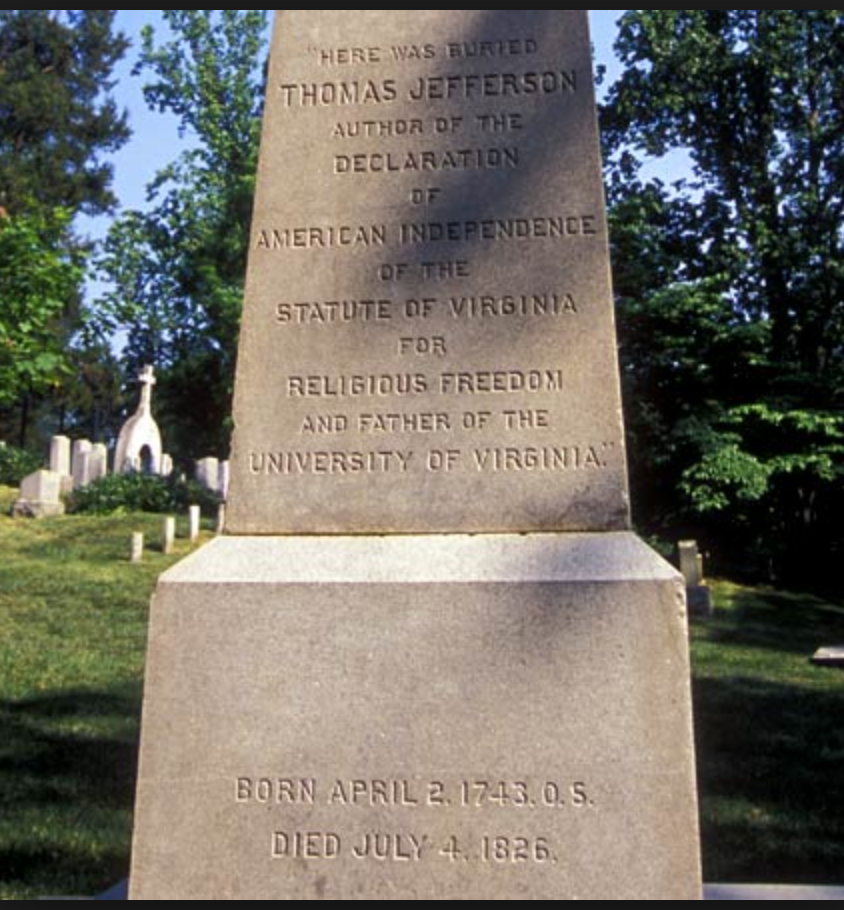
Thomas Jefferson’s tombstone

Thomas Jefferson and the Declaration of Independence are in the foremost of my thoughts this week as I take a moment to exhale and pause to note the change of seasons.  I want my home to reflect the important occasion – our nation’s birthday on the 4th of July – and so I have purposely delayed the inevitable daily deluge of tasks to “spruce up” our place.  (More details forthcoming).

Doing so allows my mind to wander, think, and reflect.  How fitting it is that this week, in particular, the Supreme Court’s ruling to uphold the right of “closely held” companies to religious liberty would come down.  Most tout the decision as good for religious freedom – and rightly so.  But I can’t help but wonder why just “closely held” companies?  Is America not founded on the proposition that all men are created equal – their equality existing in each’s equal, natural rights bestowed by The Creator?  If this is the case, why would the “number” of equal souls matter?  Is the right of religious freedom contingent on a number – an “if-then” scenario?  If so, who gets to determine the threshold – “the number”?

Worth noting are the three accomplishments for which Jefferson wished to be remembered on his tombstone:  (1) author of the Declaration of Independence; (2) father of the University of Virginia; and (3) author of the Virginia Statute for Religious Freedom.  Conspicuously absent was his service as the 3rd President of the United States.  Drafted in 1777 yet not adopted until 1787, the law states:  “That to compel a man to furnish contributions of money for the propagation of opinions which he disbelieves and abhors, is sinful and tyrannical; . . . the opinions of men are not the object of civil government, nor under its jurisdiction;”

In response to a query about the Declaration of Independence near the end of his life, Jefferson wrote:  “This was the object of the Declaration . . . to place before mankind the common sense of the subject, in terms so plain and firm as to command their assent . . . it was intended to be an expression of the American mind, and to give to that expression the proper tone and spirit called for by the occasion.”

Perhaps the foundational principles of civil and religious liberty are still an expression of the American mind.


Personal Note: “Harassed” like John Adams!

Screen Shot 2014-04-16 at 12.05.06 PM

Ugh!  I can’t believe it’s been two months since my last post.  So much for my New Year’s resolution of chronicling the daily trials of rebuilding “the original American brand”!   Today I had hoped to capitalize on a rare occasion of uninterrupted time (between the hours of 8 a.m. and 3 p.m., of course, while my kids are at school) – to compose a thoughtful editorial/essay on the anniversary of the Boston Marathon bombing.  If my essay was succinct and insightful then hopefully it would land on the editorial pages of a newspaper or two . . . ok, I’d settle for the local newspaper, The Waco Tribune-Herald; After all, you gotta start somewhere, right?!  (This was the fate of my first attempt – a tribute to Lincoln on President’s Day – something I’d felt compelled to write about for a couple of years . . . so much for efficiency).  Not so fast!  On the way to school, my fourteen year old son had a meltdown and begged to skip school, which is unusual for him.  Mother’s intuition kicked into overdrive.  After dropping the younger two kids at school, I fired off a cautionary email that was met with record response by a respected coach on the other end of my phone line.  A lengthy conversation ensued – with me doing my fair share of the talking – and a game plan was adopted to resolve the simmering crisis.  Having averted the aforementioned teenager crisis, I rushed to complete a few other morning chores like (1) pinning the horses in their stalls so they don’t gorge themselves on the fresh green “spring” grass and “founder” (like last spring), (2) releasing the chickens from their coop so they can “free range”, and (3) feeding Carl, our pet pig, who in actuality is a feral hog that we’ve raised for the last year and a half.  Another topic for another day!

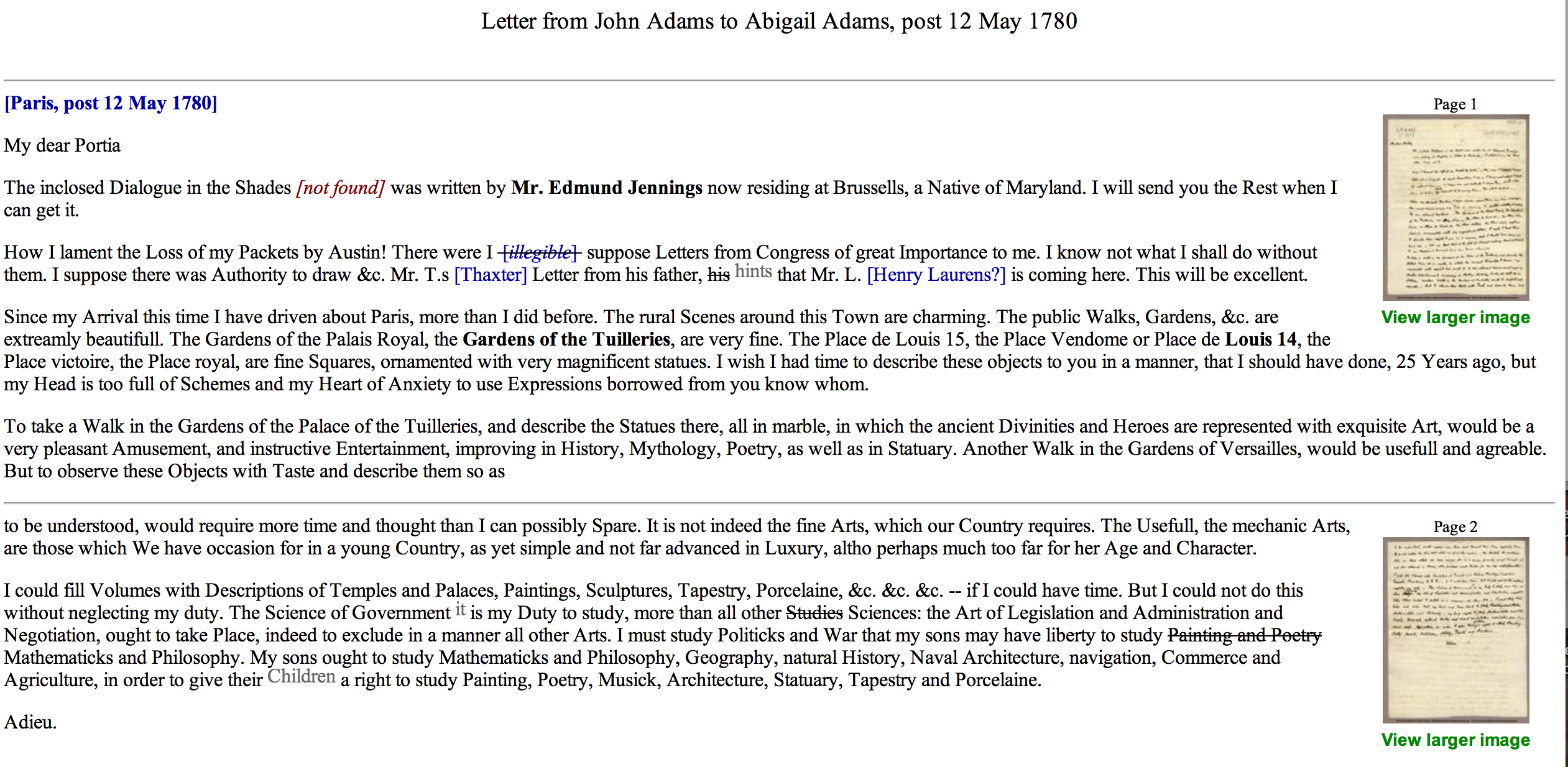
All this reminds me of a letter John Adams penned to his wife Abigail in 1780 while he was our French diplomat.  Adams described his life as “harassed” because he’s terribly busy and had to spend all his time studying ‘government and administration’ so that he could fulfill his duty during the Revolutionary War.  It’s apparent in the letter that Adams felt he had a vital and particular role and that he had to get it right.  His work as a statesman was for something – a higher purpose.  That higher purpose is called “the laws of nature and of natures God” in the Declaration of Independence.  Knowledge of these things, available in the great works of literature and philosophy (and by simply looking around you once you know what to look for), is highly desirable and necessary to securing and maintaining our freedom in America, according to our Founders.  Knowledge of Natural Law is all but absent in America today.  I certainly had no knowledge of it until I began creating The Liberty Brand.

My point is that I, too, feel like I have a particular role to play today in addition to being a mother.  Perhaps because I am a mother.  I don’t presume that I’ll have the impact Adams had, after all, he more than anyone else provoked the writing of the Declaration, recommended Thomas Jefferson author it, and secured France’s alliance in the Revolutionary War.  Tall shoes to fill!  But I love America and I love my children and want nothing more than for both to grow and prosper.  My hope is that The Liberty Brand can successfully capture and showcase the history and meaning of America, thereby making a ‘visual appeal’ for the founding.

The Liberty Brand is a worthy pursuit – the founders would argue, the ultimate pursuit – and I’ll doggedly pursue it . . . all the while being “harassed”!

PRESIDENT’S DAY: “Lincoln Sense – A Penny for Abe’s Thoughts”

Screen Shot 2014-02-09 at 11.38.36 AMDaunted yet compelled to pay a heartfelt tribute to America’s 16th president, the challenge of capturing such sentiments is compounded by the fact that the subject was indisputably one of the most eloquent prose writers of the nineteenth century.  Perhaps his own words can be of assistance.  At this juncture in our political life and at the occasions of President’s day and his recent birthday, let us pause to reflect on Lincoln’s indelible mark on “the hearts of the people for whom he saved the union.”  “It is altogether fitting and proper that we should do this.”

Lincoln used his understanding of the relationship between the Constitution and the Declaration of Independence to successfully confront and resolve the most serious existential crisis faced by America since the Revolution.  In the unpublished “Fragment on the Constitution and the Union”,  Lincoln enlisted one his famous biblical allusions to describe this relationship.  Drawing on the King James translation of Proverbs 25:11 –   “A word fitly spoken is like apples of gold in pictures of silver” –  he likened the Declaration to the “apple of gold” and the Constitution (and the union) to the silver frame or “picture of silver” wrapped around it.  “The picture was made not to conceal, or destroy the apple; but to adorn, and preserve it.  The picture was made for the apple – not the apple for the picture.”  Lincoln understood the Constitution as the embodiment or fulfillment of the principle of liberty to all expressed in the Declaration.

It was the inseparable nature of the Constitution and the Declaration that allowed us to discern that slavery was wrong. To do otherwise, Lincoln argued, would presume that slavery and freedom were moral equivalents.  Therefore, those who stopped short of recognizing the equal, natural rights of every human being were incorrect in their understanding of the American regime.  Chief Justice Taney’s assertion of the right of property in slaves, for example, was flawed in that it considered the Constitution independently of the purpose for which it was designed to serve.

Continuing in “The Fragment”, Lincoln noted, “The assertion of that principle, at that time, was the word, ‘fitly spoken’ which has proved an ‘apple of gold’ to us.”  Lincoln believed that the transcendent principle of liberty to all was the “father of all moral principles” and the “electric cord” that united liberty loving people in every age.  In other words it gave America a cohesion, by melding (hint:  melting pot) a diverse population into one people by a common commitment to a moral principle, hence “e pluribus unum.”  Implicit in this universal truth was the understanding that our rights stem from what we all have in common – our human nature – as opposed to our differences.  Additionally, in his “Speech on the Dred Scott Decision” Lincoln maintained that “The assertion that ‘all men are created equal’ was of no practical use in effecting our separation from Great Britain; and it was placed in the Declaration, nor for that, but for future use.  Its authors meant it to be, thank God, it is now proving itself, a stumbling block to those who in after times might seek to turn a free people back into the hateful paths of despotism.  They knew the proneness of prosperity to breed tyrants, and they meant when such should reappear in this fair land and commence their vocation they should find left for them at least one hard nut to crack.”  Sound familiar?

“Today we are a nation half committed to the American founding and the constitutionalism that flows from it and half committed to progressivism and the modern state,” Hillsdale professor Dr. Portteus notes.  “It is unclear, just as in Lincoln’s own time, whether we will return to our founding principles or take the last steps toward becoming a progressive state and completely rejecting the original ideal for which the revolutionary struggle was made.”  Lincoln asked rhetorically in “A House Divided” speech:  “Have we no tendency to the latter condition?”

Lincoln’s standard of leadership stands in stark contrast to present day politicians, where principles are shaped by public opinion and acted upon only when a voting majority exists.  He faithfully fulfilled his oath to “preserve, protect and defend the Constitution . . .”, adhering to its spirit and intent as opposed to seeking to “fundamentally transform” the nature of the relationship between the government and the governed.  Belief in America’s founding principles necessitated Lincoln’s actions and ironically, he, too, “gave the last full measure of devotion.”  May President Lincoln “not have died in vain.”

By Design: Why Natural Law Matters

Screen Shot 2013-08-13 at 2.38.41 PM

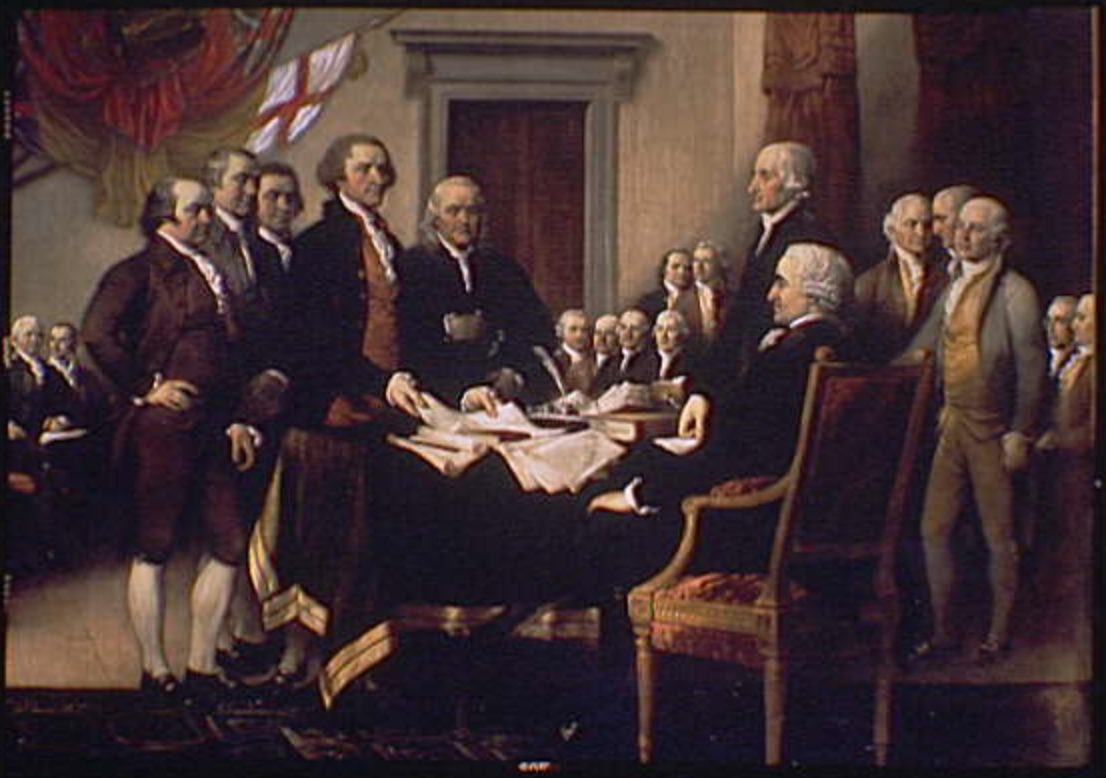
John Trumbull’s “Declaration of Independence, July 4, 1776”

Cicero, a favorite political philosopher of the Founding Fathers, was the first to speak of Natural Law as a moral or political law.  In his books on the Republic and the Laws, he projected the grandeur and promise of a future society based on Natural Law.  The American Founders had a profound appreciation for Cicero because they shared his vision of a commonwealth of prosperity and justice for themselves and their posterity.  In his writings the Founders recognized the necessary ingredients for the model society they hoped to build.  According to Cicero, true law is “right reason.”  Constant and eternal, it is in accordance with nature.  He characterized the universal law this way:

“There will not be one law at Rome and another at Athens, one now and another later; but all nations at all times will be bound by this one eternal and unchangeable law, and the god will be the one common master and general of all people.  He is the author, expounder, and mover of this law; and the person who does not obey it will be in exile from himself.  Insofar as he scorns his nature as a human being, by this very fact he will pay the greatest penalty, even if he escapes all the other things that are generally recognized as punishments . . .”

Belief in the moral truth of Natural Law inspired the Founders and spurred their quest for independence.  In fact, The Declaration is “an act of obedience to a law that persists beyond the English law and beyond any law that the Founders themselves might make, notes Dr. Arynn, President of Hillsdale College.  It is an act of obedience to the ‘Laws of Nature and of Nature’s God,’ and to certain self-evident truths,” primarily the equal and unalienable Rights of all human beings.  To live in ignorance and disregard for the moral principles of Natural Law is to risk exile from life’s ultimate goods like the inestimable blessings of civil and religious liberty.