
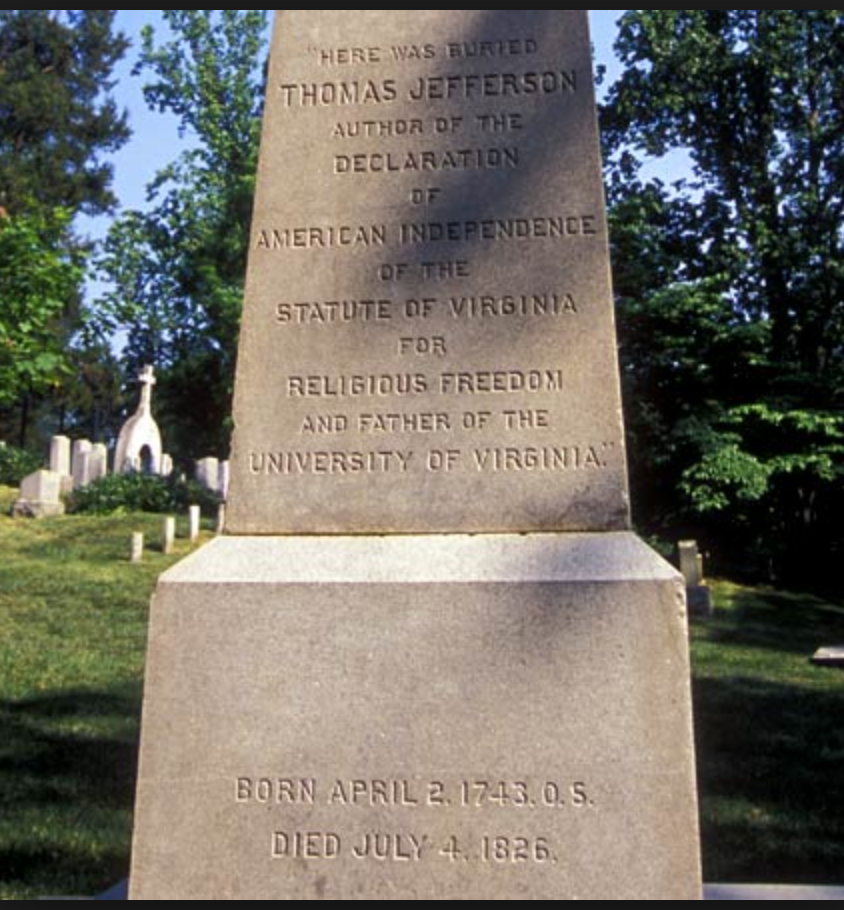
Thomas Jefferson’s tombstone
Thomas Jefferson and the Declaration of Independence are in the foremost of my thoughts this week as I take a moment to exhale and pause to note the change of seasons. I want my home to reflect the important occasion – our nation’s birthday on the 4th of July – and so I have purposely delayed the inevitable daily deluge of tasks to “spruce up” our place. (More details forthcoming).
Doing so allows my mind to wander, think, and reflect. How fitting it is that this week, in particular, the Supreme Court’s ruling to uphold the right of “closely held” companies to religious liberty would come down. Most tout the decision as good for religious freedom – and rightly so. But I can’t help but wonder why just “closely held” companies? Is America not founded on the proposition that all men are created equal – their equality existing in each’s equal, natural rights bestowed by The Creator? If this is the case, why would the “number” of equal souls matter? Is the right of religious freedom contingent on a number – an “if-then” scenario? If so, who gets to determine the threshold – “the number”?
Worth noting are the three accomplishments for which Jefferson wished to be remembered on his tombstone: (1) author of the Declaration of Independence; (2) father of the University of Virginia; and (3) author of the Virginia Statute for Religious Freedom. Conspicuously absent was his service as the 3rd President of the United States. Drafted in 1777 yet not adopted until 1787, the law states: “That to compel a man to furnish contributions of money for the propagation of opinions which he disbelieves and abhors, is sinful and tyrannical; . . . the opinions of men are not the object of civil government, nor under its jurisdiction;”
In response to a query about the Declaration of Independence near the end of his life, Jefferson wrote: “This was the object of the Declaration . . . to place before mankind the common sense of the subject, in terms so plain and firm as to command their assent . . . it was intended to be an expression of the American mind, and to give to that expression the proper tone and spirit called for by the occasion.”
Perhaps the foundational principles of civil and religious liberty are still an expression of the American mind.



 The Liberty Belle Blog