
When I’m feeling anxious – alot lately – I find solace, inspiration, and direction in the life of Abraham Lincoln. The following is a perfect example of why. Lincoln once wrote to a clergyman, “If it were not for my firm belief in an over-ruling providence, it would be difficult for me, in the midst of such complications of affairs, to keep my reason in its seat. But I am confident that the Almighty has His plans and will work them out; and whether we see it or not, they will be the wisest and best for us.” And when another minister expressed his hope that the Lord is on the side of the North, Lincoln responded: “I am not at all concerned about that, for I know that the Lord is always on the side of the right. But it is my constant anxiety and prayer that I and this nation should be on the Lord’s side.” Amen.
Civil War

PRESIDENT’S DAY: “Lincoln Sense – A Penny for Abe’s Thoughts”
 Daunted yet compelled to pay a heartfelt tribute to America’s 16th president, the challenge of capturing such sentiments is compounded by the fact that the subject was indisputably one of the most eloquent prose writers of the nineteenth century. Perhaps his own words can be of assistance. At this juncture in our political life and at the occasions of President’s day and his recent birthday, let us pause to reflect on Lincoln’s indelible mark on “the hearts of the people for whom he saved the union.” “It is altogether fitting and proper that we should do this.”
Lincoln used his understanding of the relationship between the Constitution and the Declaration of Independence to successfully confront and resolve the most serious existential crisis faced by America since the Revolution. In the unpublished “Fragment on the Constitution and the Union”, Lincoln enlisted one his famous biblical allusions to describe this relationship. Drawing on the King James translation of Proverbs 25:11 – “A word fitly spoken is like apples of gold in pictures of silver” – he likened the Declaration to the “apple of gold” and the Constitution (and the union) to the silver frame or “picture of silver” wrapped around it. “The picture was made not to conceal, or destroy the apple; but to adorn, and preserve it. The picture was made for the apple – not the apple for the picture.” Lincoln understood the Constitution as the embodiment or fulfillment of the principle of liberty to all expressed in the Declaration.
It was the inseparable nature of the Constitution and the Declaration that allowed us to discern that slavery was wrong. To do otherwise, Lincoln argued, would presume that slavery and freedom were moral equivalents. Therefore, those who stopped short of recognizing the equal, natural rights of every human being were incorrect in their understanding of the American regime. Chief Justice Taney’s assertion of the right of property in slaves, for example, was flawed in that it considered the Constitution independently of the purpose for which it was designed to serve.
Continuing in “The Fragment”, Lincoln noted, “The assertion of that principle, at that time, was the word, ‘fitly spoken’ which has proved an ‘apple of gold’ to us.” Lincoln believed that the transcendent principle of liberty to all was the “father of all moral principles” and the “electric cord” that united liberty loving people in every age. In other words it gave America a cohesion, by melding (hint: melting pot) a diverse population into one people by a common commitment to a moral principle, hence “e pluribus unum.” Implicit in this universal truth was the understanding that our rights stem from what we all have in common – our human nature – as opposed to our differences. Additionally, in his “Speech on the Dred Scott Decision” Lincoln maintained that “The assertion that ‘all men are created equal’ was of no practical use in effecting our separation from Great Britain; and it was placed in the Declaration, nor for that, but for future use. Its authors meant it to be, thank God, it is now proving itself, a stumbling block to those who in after times might seek to turn a free people back into the hateful paths of despotism. They knew the proneness of prosperity to breed tyrants, and they meant when such should reappear in this fair land and commence their vocation they should find left for them at least one hard nut to crack.” Sound familiar?
“Today we are a nation half committed to the American founding and the constitutionalism that flows from it and half committed to progressivism and the modern state,” Hillsdale professor Dr. Portteus notes. “It is unclear, just as in Lincoln’s own time, whether we will return to our founding principles or take the last steps toward becoming a progressive state and completely rejecting the original ideal for which the revolutionary struggle was made.” Lincoln asked rhetorically in “A House Divided” speech: “Have we no tendency to the latter condition?”
Lincoln’s standard of leadership stands in stark contrast to present day politicians, where principles are shaped by public opinion and acted upon only when a voting majority exists. He faithfully fulfilled his oath to “preserve, protect and defend the Constitution . . .”, adhering to its spirit and intent as opposed to seeking to “fundamentally transform” the nature of the relationship between the government and the governed. Belief in America’s founding principles necessitated Lincoln’s actions and ironically, he, too, “gave the last full measure of devotion.” May President Lincoln “not have died in vain.”
Share this:

Personal Note: What is “Lincoln Sense?”
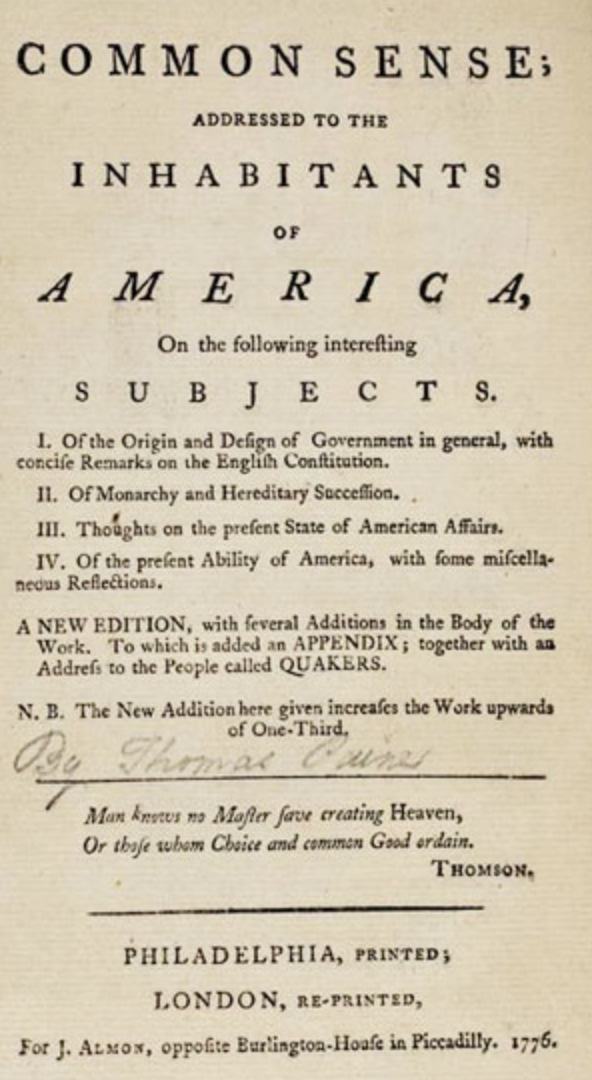 Two hundred thirty-eight years ago today, a plainspoken pamphlet entitled “Common Sense” by Thomas Paine was a “call-to-arms” for the American Revolution. It made the case for the necessity of declaring independence from Great Britain. A mere six months spanned from the publication’s debut until the colonists declared their independence in the summer of 1776, affirming the adage “the pen is mightier than the sword.” In a nod to this pamphlet I’ve entitled a special President’s Day post: “Lincoln Sense: A penny for Abe’s thoughts.” I pay tribute to our 16th president, largely through his own words (can anyone say it better than he?). Lincoln eloquently and successfully made the case for returning to the founders’ model of self-government grounded in transcendent moral truth, which guided the nation though its most serious existential crisis since the Revolution. And he can do it again, if Americans have the common sense to apply “Lincoln Sense.”
Share this:

Personal Note: Amazing Coincidence or Divine Sign at Office Depot Today?
I ran into Office Depot today to get some nice, resume quality paper – something I like to keep on hand . Though I didn’t have a particular brand in mind I wanted it to have a good look and feel, preferably 100% cotton and ivory in color. I found a box that met my requirements, grabbed it, and rushed over to checkout. As the cashier bagged my purchase, the box flipped over and I caught a glimpse of Abraham Lincoln printed on the back of the packaging. I was instantly transfixed but snapped out of it as I felt the cashier’s impatient gaze. I hurriedly paid, while commenting that I was a history buff and couldn’t wait to find out why Lincoln’s picture was on the box!
When I got in my car, I pulled out the paper and feasted my eyes on the following:

Inscription on the box of Southworth paper I purchased today.
The message beside Lincoln’s image reads: “WHAT MESSAGE DOES YOUR DOCUMENT CONVEY? For generations, people have been relying on Southworth papers to provide greater impact to their ideas. In fact, President Lincoln chose Southworth paper to accept Stephen Douglas’s invitation to debate, documenting the seriousness and historic nature of the event. . .”
While I recognize that only those closest to me – those who have shared the 2 1/2 year journey of bringingThe Liberty Brand (TLB) to life- can fully appreciate the impact of this revelation, I , nevertheless, couldn’t resist sharing and noting it. That it occurred in February, mere days away from Lincoln’s birthday, amplified its impact. Lincoln’s understanding of the relationship between the Constitution and the Declaration of Independence is central to The Liberty Brand’s message.
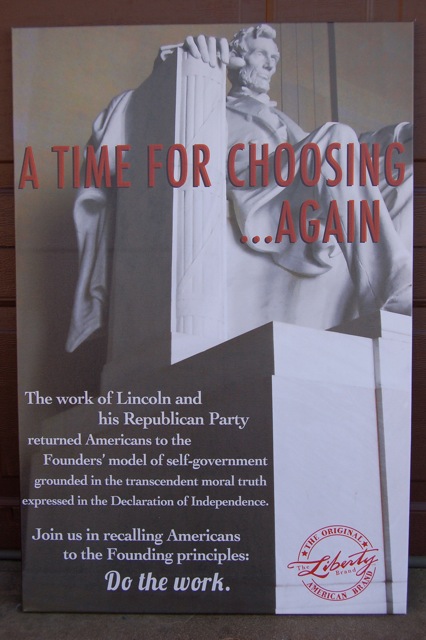
Canvas of promotional poster highlighting the choice America faces today
In fact, at Christmas my sister-in-law presented me with a canvas of a promotional poster designed to capture these sentiments and serve as a focal point in TLBCo.’s flagship shop.
Share this:

Personal Note: A Quiet Constitution Day
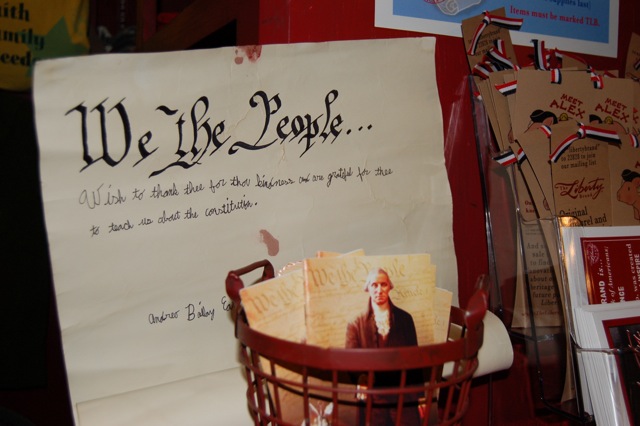 Yesterday marked a departure in my annual Constitution Day festivities. For the last 3 years I’ve gone to one of my kids’ elementary school classrooms and thrown a birthday party for the Constitution complete with cookie cake, candles, patriotic plates and napkins, party favors and a brief presentation about the honoree. Kids know birthday parties so it’s fun way to highlight and celebrate the Constitution while piquing their interest in the subject. I always leave feeling renewed and excited about the possibility and potential of helping our kids – “Liberty’s kids” – to learn to love these things. And seeing their faces light up does a mom’s heart “good”. All is not lost if we look for fun and innovative ways to celebrate our country’s unique and exceptional heritage. I believe there’s a document that reminds us we have a duty to do these things but it’s birthday is in July!

 The Liberty Belle Blog