
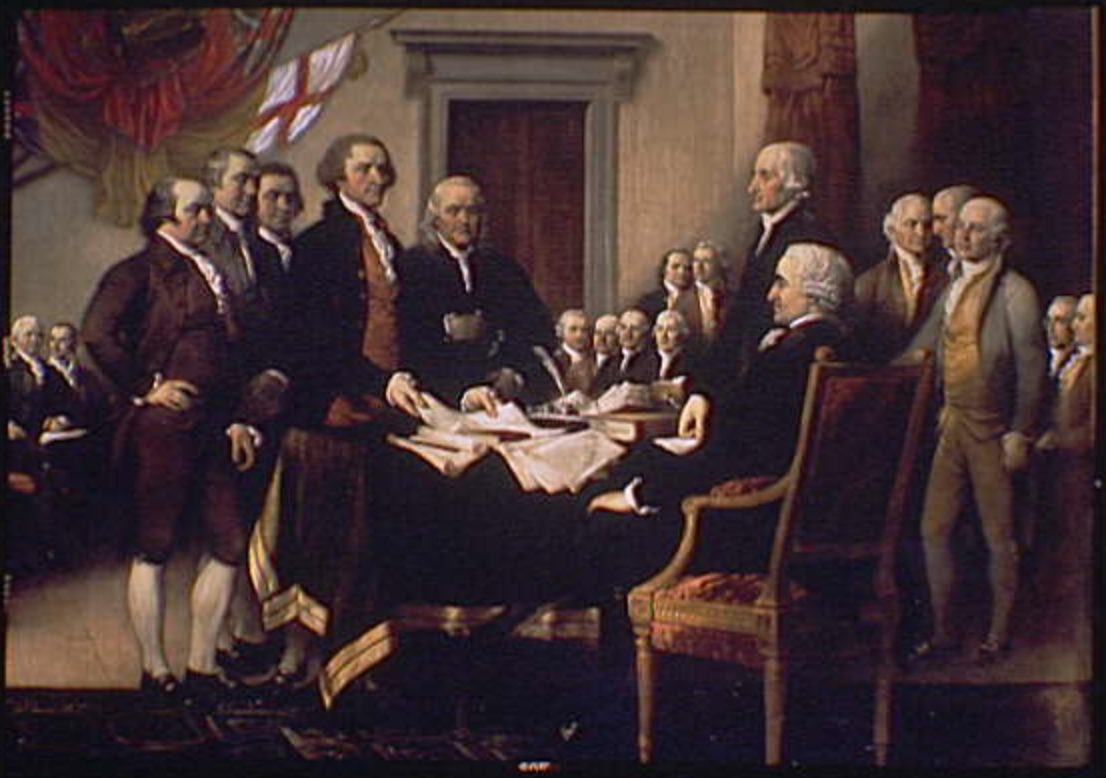
John Trumbull’s “Declaration of Independence, July 4, 1776”
Cicero, a favorite political philosopher of the Founding Fathers, was the first to speak of Natural Law as a moral or political law. In his books on the Republic and the Laws, he projected the grandeur and promise of a future society based on Natural Law. The American Founders had a profound appreciation for Cicero because they shared his vision of a commonwealth of prosperity and justice for themselves and their posterity. In his writings the Founders recognized the necessary ingredients for the model society they hoped to build. According to Cicero, true law is “right reason.” Constant and eternal, it is in accordance with nature. He characterized the universal law this way:
“There will not be one law at Rome and another at Athens, one now and another later; but all nations at all times will be bound by this one eternal and unchangeable law, and the god will be the one common master and general of all people. He is the author, expounder, and mover of this law; and the person who does not obey it will be in exile from himself. Insofar as he scorns his nature as a human being, by this very fact he will pay the greatest penalty, even if he escapes all the other things that are generally recognized as punishments . . .”
Belief in the moral truth of Natural Law inspired the Founders and spurred their quest for independence. In fact, The Declaration is “an act of obedience to a law that persists beyond the English law and beyond any law that the Founders themselves might make, notes Dr. Arynn, President of Hillsdale College. It is an act of obedience to the ‘Laws of Nature and of Nature’s God,’ and to certain self-evident truths,” primarily the equal and unalienable Rights of all human beings. To live in ignorance and disregard for the moral principles of Natural Law is to risk exile from life’s ultimate goods like the inestimable blessings of civil and religious liberty.




 The Liberty Belle Blog